
English has evolved over thousands of years, changing and adapting to suit the needs of the people who speak it. Someone alive twenty generations ago would have spoken a completely different version of English to the one we use today.
Let’s go back to where it all started.
Have you ever noticed similarities between languages? For example, the German word for apple, apfel, is similar to the English term for the word. These two languages are similar because they belong to the same language family. Learning about the definition of language families and some examples can enhance one’s understanding of how languages are related.
The
making of E. is the story of 3 invasions and Cultural Revolution. The
L was brought to Britain by Germanic tribes (Angles, Saxons, Jutes),
influenced by Latin and Greece, and enriched by Danes and finally
transformed by the French speaking Normans. From the beginning
English was a hybrid of several lang-es and was created in war and
peace.
The
E. was originated from anglo-friesian dialects, which formed part of
the West Germ group.
The
earliest mention of Br. Isles was made in the 4 cent.BC, when Greek
explorer Pytheus landed in Kent. At this time Britain was inhabited
by Celtic
tribes:
Britons and Gaels who spoke various Celtic L.
The
permanent conquest of Br began in 43 AD under the emperor Claudius.
Br became a roman province. The Latin L spread over the country. The
Romans ruled Br 4 c. up to the 5th
c. In 5 cent Britain was invaded by German tribes (Angles, Saxons,
Jutes),who formed their kingdoms(Kent, Essex, Wessex, Sussex, East
Anglia, Mercia, Northumbria). 3 cent. After the event the Venerable
Bede wrote his “Historia Ecclesiastica Gentis Anglorum” in Latin.
These people were called Angelcyhn and their lang. was Englisc. By
1000AD the country was known as “Englaland”. 100 most common E
words are of Anglo-Saxon origin(the,is,you,mann,drincan).
“The
Exeder book of riddles”-old E culture.
597-
The Christianity was brought to England with its Latin vocabulary. It
enriched the vocabulary and gave English the opportunity to express
extra thoughts. Such words came from Latin(disciple(ученик),
preost(священник),
nonne(монашка),biscop
) from Greek
(pope,
psalter,
apostle).
Vikings.
The
mass movement of Scandinavian people (750-1050)-one of the greatest
migration in history. Unlike the A-S race war against the Celts,
which preserved practically no trace of the Celtic L within English,
the Danish settlers had profound influence on all English.
Alfred
the Great was so called for his thoughts of creating the idea of
national identity—Englishness conveyed by the language. He began
rebuilding schools and monasteries, introducing English, not Latin.
At the age of 40 he learned Latin to translate texts. He instituted
the Chronicle, which was unique in Europe. He is called Savior of the
English L and prose.
Evidence
of the way Saxons and Danes lived alongside each other is in the
place names that survived to this day.
Saxon:
ending in – ham, -ing, -stowe, -sted, -ton.Danish:
ending
in –by, wick, -scale, -thorpe, -toft, -thwait.
The
impact of Old North(старо
норвежск.)
is great, because of the great similarity of these
lang-es.Scandinavian:
900
words(man, wife, winter, house, summer, mother).
The
fusion of Saxons and Vikings can be observed in “Beowulf”(3000
lines.)
The history of English is conventionally, if perhaps too neatly, divided into three periods usually called Old English (or Anglo-Saxon), Middle English, and Modern English. The earliest period begins with the migration of certain Germanic tribes from the continent to Britain in the fifth century A.D., though no records of their language survive from before the seventh century, and it continues until the end of the eleventh century or a bit later. By that time Latin, Old Norse (the language of the Viking invaders), and especially the Anglo-Norman French of the dominant class after the Norman Conquest in 1066 had begun to have a substantial impact on the lexicon, and the well-developed inflectional system that typifies the grammar of Old English had begun to break down.
Eft he axode, hu ðære ðeode nama wære þe hi of comon. Him wæs geandwyrd, þæt hi Angle genemnode wæron. Þa cwæð he, «Rihtlice hi sind Angle gehatene, for ðan ðe hi engla wlite habbað, and swilcum gedafenað þæt hi on heofonum engla geferan beon.»
Some of the words in the original have survived in altered form, including axode (asked), hu (how), rihtlice (rightly), engla (angels), habbað (have), swilcum (such), heofonum (heaven), and beon (be). Others, however, have vanished from our lexicon, mostly without a trace, including several that were quite common words in Old English: eft «again,» ðeode «people, nation,» cwæð «said, spoke,» gehatene «called, named,» wlite «appearance, beauty,» and geferan «companions.» Recognition of some words is naturally hindered by the presence of two special characters, þ, called «thorn,» and ð, called «edh,» which served in Old English to represent the sounds now spelled with th.
Other points worth noting include the fact that the pronoun system did not yet, in the late tenth century, include the third person plural forms beginning with th-: hi appears where we would use they. Several aspects of word order will also strike the reader as oddly unlike ours. Subject and verb are inverted after an adverb—þa cwæð he «Then said he»—a phenomenon not unknown in Modern English but now restricted to a few adverbs such as never and requiring the presence of an auxiliary verb like do or have. In subordinate clauses the main verb must be last, and so an object or a preposition may precede it in a way no longer natural: þe hi of comon «which they from came,» for ðan ðe hi engla wlite habbað «because they angels’ beauty have.»
Perhaps the most distinctive difference between Old and Modern English reflected in Aelfric’s sentences is the elaborate system of inflections, of which we now have only remnants. Nouns, adjectives, and even the definite article are inflected for gender, case, and number: ðære ðeode «(of) the people» is feminine, genitive, and singular, Angle «Angles» is masculine, accusative, and plural, and swilcum «such» is masculine, dative, and plural. The system of inflections for verbs was also more elaborate than ours: for example, habbað «have» ends with the -að suffix characteristic of plural present indicative verbs. In addition, there were two imperative forms, four subjunctive forms (two for the present tense and two for the preterit, or past, tense), and several others which we no longer have. Even where Modern English retains a particular category of inflection, the form has often changed. Old English present participles ended in -ende not -ing, and past participles bore a prefix ge- (as geandwyrd «answered» above).
In þat lond ben trees þat beren wolle, as þogh it were of scheep; whereof men maken clothes, and all þing þat may ben made of wolle. In þat contree ben many ipotaynes, þat dwellen som tyme in the water, and somtyme on the lond: and þei ben half man and half hors, as I haue seyd before; and þei eten men, whan þei may take hem. And þere ben ryueres and watres þat ben fulle byttere, þree sithes more þan is the water of the see. In þat contré ben many griffounes, more plentee þan in ony other contree. Sum men seyn þat þei han the body vpward as an egle, and benethe as a lyoun: and treuly þei seyn soth þat þei ben of þat schapp. But o griffoun hath the body more gret, and is more strong, þanne eight lyouns, of suche lyouns as ben o this half; and more gret and strongere þan an hundred egles, suche as we han amonges vs. For o griffoun þere wil bere fleynge to his nest a gret hors, 3if he may fynde him at the poynt, or two oxen 3oked togidere, as þei gon at the plowgh.
We may notice a few words and phrases that have meanings no longer common such as byttere «salty,» o this half «on this side of the world,» and at the poynt «to hand,» and the effect of the centuries-long dominance of French on the vocabulary is evident in many familiar words which could not have occurred in Aelfric’s writing even if his subject had allowed them, words like contree, ryueres, plentee, egle, and lyoun.
In general word order is now very close to that of our time, though we notice constructions like hath the body more gret and three sithes more þan is the water of the see. We also notice that present tense verbs still receive a plural inflection as in beren, dwellen, han, and ben and that while nominative þei has replaced Aelfric’s hi in the third person plural, the form for objects is still hem.
All the same, the number of inflections for nouns, adjectives, and verbs has been greatly reduced, and in most respects Mandeville is closer to Modern than to Old English.
The period of Modern English extends from the sixteenth century to our own day. The early part of this period saw the completion of a revolution in the phonology of English that had begun in late Middle English and that effectively redistributed the occurrence of the vowel phonemes to something approximating their present pattern. (Mandeville’s English would have sounded even less familiar to us than it looks.)
Other important early developments include the stabilizing effect on spelling of the printing press and the beginning of the direct influence of Latin and, to a lesser extent, Greek on the lexicon. Later, as English came into contact with other cultures around the world and distinctive dialects of English developed in the many areas which Britain had colonized, numerous other languages made small but interesting contributions to our word-stock.
- Indo-European and Germanic Influences
- Old English (500-1100 AD)
- The Norman Conquest and Middle English (1100-1500)
- Early Modern English (1500-1800)
- Late-Modern English (1800-Present)
- American English
- A Chronology of the English Language
- Language Family
- Afro-Asiatic
- Austronesian
- Indo-European
- Niger-Congo
- Sino-Tibetan
- Trans-New Guinea
- The English Language Family
- History of English language
- Old English (5th-11th century)
- Middle English (ca. 11th-15th century)
- Early Modern English (ca. 15th-18th century)
- Late modern English (ca. 18th-Present)
- History of English Language
- The History of English Language — Key takeaways
- Language Family — Key takeaways
- Language Family
- A short history of English language
- History of English language
- The chronological division of the history of English.
- История английского языка буквально на пальцах
- До зари времен
- Древнеанглийский — для настоящих хардкорщиков
- Среднеанглийский язык — уже можно читать (ну почти)
- Новоанглийский язык: от Шекспира до наших дней
- Онлайн-школа EnglishDom.com — вдохновляем выучить английский через технологии и человеческую заботу
- The Largest Language Family
- Language Family
- References
Indo-European and Germanic Influences
English is a member of the Indo-European family of languages. This broad family includes most of the European languages spoken today. The Indo-European family includes several major branches:
- Latin and the modern Romance languages;
- The Germanic languages;
- The Indo-Iranian languages, including Hindi and Sanskrit;
- The Slavic languages;
- The Baltic languages of Latvian and Lithuanian (but not Estonian);
- The Celtic languages; and
- Greek.
Of these branches of the Indo-European family, two are, for our purposes of studying the development of English, of paramount importance, the Germanic and the Romance (called that because the Romance languages derive from Latin, the language of ancient Rome, not because of any bodice-ripping literary genre). English is in the Germanic group of languages. This group began as a common language in the Elbe river region about 3,000 years ago. Around the second century BC, this Common Germanic language split into three distinct sub-groups:
- East Germanic was spoken by peoples who migrated back to southeastern Europe. No East Germanic language is spoken today, and the only written East Germanic language that survives is Gothic.
- North Germanic evolved into the modern Scandinavian languages of Swedish, Danish, Norwegian, and Icelandic (but not Finnish, which is related to Estonian and is not an Indo-European language).
- West Germanic is the ancestor of modern German, Dutch, Flemish, Frisian, and English.
Old English (500-1100 AD)
West Germanic invaders from Jutland and southern Denmark: the Angles (whose name is the source of the words England and English), Saxons, and Jutes, began populating the British Isles in the fifth and sixth centuries AD. They spoke a mutually intelligible language, similar to modern Frisian–the language of northeastern region of the Netherlands–that is called Old English. Four major dialects of Old English emerged, Northumbrian in the north of England, Mercian in the Midlands, West Saxon in the south and west, and Kentish in the Southeast.
These invaders pushed the original, Celtic-speaking inhabitants out of what is now England into Scotland, Wales, Cornwall, and Ireland, leaving behind a few Celtic words. These Celtic languages survive today in Gaelic languages of Scotland and Ireland and in Welsh. Cornish, unfortunately, is now a dead language. (The last native Cornish speaker, Dolly Pentreath, died in 1777 in the town of Mousehole, Cornwall.) Also influencing English at this time were the Vikings. Norse invasions, beginning around 850, brought many North Germanic words into the language, particularly in the north of England. Some examples are dream, which had meant ‘joy’ until the Vikings imparted its current meaning on it from the Scandinavian cognate draumr, and skirt, which continues to live alongside its native English cognate shirt.
The majority of words in modern English come from foreign, not Old English roots. In fact, only about one sixth of the known Old English words have descendants surviving today. But this is deceptive; Old English is much more important than these statistics would indicate. About half of the most commonly used words in modern English have Old English roots. Words like be, water, and strong, for example, derive from Old English roots.
Old English, whose best known surviving example is the poem Beowulf, lasted until about 1100. This last date is rather arbitrary, but most scholars choose it because it is shortly after the most important event in the development of the English language, the Norman Conquest.
The Norman Conquest and Middle English (1100-1500)
William the Conqueror, the Duke of Normandy, invaded and conquered England and the Anglo-Saxons in 1066 AD. (The Bayeux Tapestry, details of which form the navigation buttons on this site, is perhaps the most famous graphical depiction of the Norman Conquest.) The new overlords spoke a dialect of Old French known as Anglo-Norman. The Normans were also of Germanic stock (“Norman” comes from “Norseman”) and Anglo-Norman was a French dialect that had considerable Germanic influences in addition to the basic Latin roots.
Prior to the Norman Conquest, Latin had been only a minor influence on the English language, mainly through vestiges of the Roman occupation and from the conversion of Britain to Christianity in the seventh century (ecclesiastical terms such as priest, vicar, and mass came into the language this way), but now there was a wholesale infusion of Romance (Anglo-Norman) words.
The influence of the Normans can be illustrated by looking at two words, beef and cow. Beef, commonly eaten by the aristocracy, derives from the Anglo-Norman, while the Anglo-Saxon commoners, who tended the cattle, retained the Germanic cow. Many legal terms, such as indict, jury, and verdict have Anglo-Norman roots because the Normans ran the courts. This split, where words commonly used by the aristocracy have Romantic roots and words frequently used by the Anglo-Saxon commoners have Germanic roots, can be seen in many instances.
Sometimes French words replaced Old English words; crime replaced firen and uncle replaced eam. Other times, French and Old English components combined to form a new word, as the French gentle and the Germanic man formed gentleman. Other times, two different words with roughly the same meaning survive into modern English. Thus we have the Germanic doom and the French judgment, or wish and desire.
It is useful to compare various versions of a familiar text to see the differences between Old, Middle, and Modern English. Take for instance this Old English (c.1000) sample:
Fæder ure þuþe eart on heofonum
si þin nama gehalgod tobecume þin rice gewurþe þin willa on eorðan swa swa on heofonum
urne gedæghwamlican hlaf syle us to dæg
and forgyf us ure gyltas swa swa we forgyfað urum gyltendum
and ne gelæd þu us on costnunge ac alys us of yfele soþlice.
To get a feel for Old English pronunciation, play a wav file of this Old English text (518Kb), read by Catherine Ball of Georgetown University.
Rendered in Middle English (Wyclif, 1384), the same text is recognizable to the modern eye:
Oure fadir þat art in heuenes halwid be þi name;
þi reume or kyngdom come to be. Be þi wille don in herþe as it is dounin heuene.
yeue to us today oure eche dayes bred.
And foryeue to us oure dettis þat is oure synnys as we foryeuen to oure dettouris þat is to men þat han synned in us.
And lede us not into temptacion but delyuere us from euyl.
Finally, in Early Modern English (King James Version, 1611) the same text is completely intelligible:
Our father which art in heauen, hallowed be thy name.
Thy kingdom come. Thy will be done in earth as it is in heauen.
Giue us this day our daily bread.
And forgiue us our debts as we forgiue our debters.
And lead us not into temptation, but deliuer us from euill. Amen.
In 1204 AD, King John lost the province of Normandy to the King of France. This began a process where the Norman nobles of England became increasingly estranged from their French cousins. England became the chief concern of the nobility, rather than their estates in France, and consequently the nobility adopted a modified English as their native tongue. About 150 years later, the Black Death (1349-50) killed about one third of the English population. The laboring and merchant classes grew in economic and social importance, and along with them English increased in importance compared to Anglo-Norman.
This mixture of the two languages came to be known as Middle English. The most famous example of Middle English is Chaucer’s Canterbury Tales. Unlike Old English, Middle English can be read, albeit with difficulty, by modern English-speaking people.
By 1362, the linguistic division between the nobility and the commoners was largely over. In that year, the Statute of Pleading was adopted, which made English the language of the courts and it began to be used in Parliament.
The Middle English period came to a close around 1500 AD with the rise of Modern English.
Early Modern English (1500-1800)
The next wave of innovation in English came with the Renaissance. The revival of classical scholarship brought many classical Latin and Greek words into the Language. These borrowings were deliberate and many bemoaned the adoption of these “inkhorn” terms, but many survive to this day. Shakespeare’s character Holofernes in Loves Labor Lost is a satire of an overenthusiastic schoolmaster who is too fond of Latinisms.
Many students having difficulty understanding Shakespeare would be surprised to learn that he wrote in modern English. But, as can be seen in the earlier example of the Lord’s Prayer, Elizabethan English has much more in common with our language today than it does with the language of Chaucer. Many familiar words and phrases were coined or first recorded by Shakespeare, some 2,000 words and countless catch-phrases are his. Newcomers to Shakespeare are often shocked at the number of cliches contained in his plays, until they realize that he coined them and they became cliches afterwards. “One fell swoop,” “vanish into thin air,” and “flesh and blood” are all Shakespeare’s. Words he bequeathed to the language include “critical,” “leapfrog,” “majestic,” “dwindle,” and “pedant.”
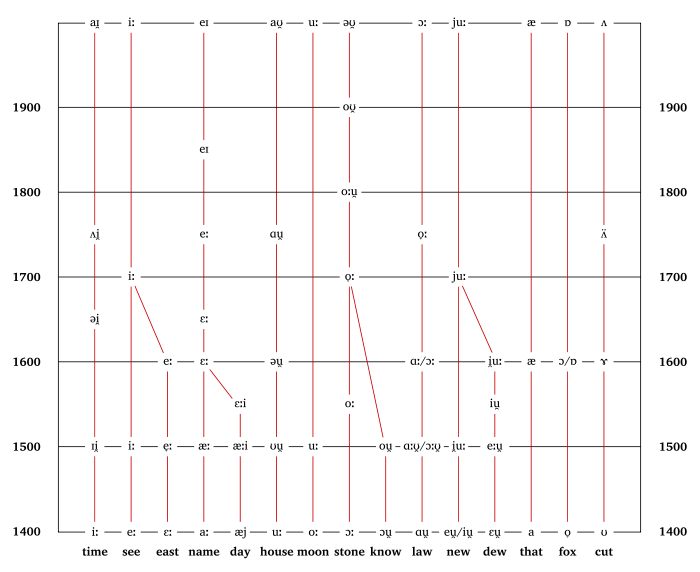
Two other major factors influenced the language and served to separate Middle and Modern English. The first was the Great Vowel Shift. This was a change in pronunciation that began around 1400. While modern English speakers can read Chaucer with some difficulty, Chaucer’s pronunciation would have been completely unintelligible to the modern ear. Shakespeare, on the other hand, would be accented, but understandable. Long vowel sounds began to be made higher in the mouth and the letter “e” at the end of words became silent. Chaucer’s Lyf (pronounced “leef”) became the modern life. In Middle English name was pronounced “nam-a,” five was pronounced “feef,” and down was pronounced “doon.” In linguistic terms, the shift was rather sudden, the major changes occurring within a century. The shift is still not over, however, vowel sounds are still shortening although the change has become considerably more gradual.
Late-Modern English (1800-Present)
The principal distinction between early- and late-modern English is vocabulary. Pronunciation, grammar, and spelling are largely the same, but Late-Modern English has many more words. These words are the result of two historical factors. The first is the Industrial Revolution and the rise of the technological society. This necessitated new words for things and ideas that had not previously existed. The second was the British Empire. At its height, Britain ruled one quarter of the earth’s surface, and English adopted many foreign words and made them its own.
The industrial and scientific revolutions created a need for neologisms to describe the new creations and discoveries. For this, English relied heavily on Latin and Greek. Words like oxygen, protein, nuclear, and vaccine did not exist in the classical languages, but they were created from Latin and Greek roots. Such neologisms were not exclusively created from classical roots though, English roots were used for such terms as horsepower, airplane, and typewriter.
This burst of neologisms continues today, perhaps most visible in the field of electronics and computers. Byte, cyber-, bios, hard-drive, and microchip are good examples.
Also, the rise of the British Empire and the growth of global trade served not only to introduce English to the world, but to introduce words into English. Hindi, and the other languages of the Indian subcontinent, provided many words, such as pundit, shampoo, pajamas, and juggernaut. Virtually every language on Earth has contributed to the development of English, from Finnish (sauna) and Japanese (tycoon) to the vast contributions of French and Latin.
The British Empire was a maritime empire, and the influence of nautical terms on the English language has been great. Words and phrases like three sheets to the wind and scuttlebutt have their origins onboard ships.
American English
Also significant beginning around 1600 AD was the English colonization of North America and the subsequent creation of a distinct American dialect. Some pronunciations and usages “froze” when they reached the American shore. In certain respects, American English is closer to the English of Shakespeare than modern British English is. Some “Americanisms” that the British decry are actually originally British expressions that were preserved in the colonies while lost at home (e.g., fall as a synonym for autumn, trash for rubbish, frame-up which was reintroduced to Britain through Hollywood gangster movies, and loan as a verb instead of lend).
The American dialect also served as the route of introduction for many native American words into the English language. Most often, these were place names like Mississippi, Roanoke, and Iowa. Indian-sounding names like Idaho were sometimes created that had no native-American roots. But, names for other things besides places were also common. Raccoon, tomato, canoe, barbecue, savanna, and hickory have native American roots, although in many cases the original Indian words were mangled almost beyond recognition.
Spanish has also been great influence on American English. Armadillo, mustang, canyon, ranch, stampede, and vigilante are all examples of Spanish words that made their way into English through the settlement of the American West.
To a lesser extent French, mainly via Louisiana, and West African, through the importation of slaves, words have influenced American English. Armoire, bayou, and jambalaya came into the language via New Orleans. Goober, gumbo, and tote are West African borrowings first used in America by slaves.
A Chronology of the English Language
Language Family
There are six major language families.
Afro-Asiatic
The Afro-Asiatic language family includes languages spoken in the Arabian Peninsula, Northern Africa, and Western Asia. It includes smaller branches of the family, such as:
Cushitic (Ex: Somali, Beja)
Omotic (Ex: Dokka, Majo, Galila)
Semitic (Arabic, Hebrew, Maltese, etc.)
Austronesian
Central-Eastern/Oceanic (Ex: Fijian, Tongan, Maori)
Western (Ex: Indonesian, Malay, and Cebuano)
 Fig. 2 — Language families have multiple branches.
Indo-European
Slavic (Ex: Ukrainian, Russian, Slovak, Czech, Croatian)
Baltic (Ex: Latvian, Lithuanian)
Romance (French, Spanish, Italian, Latin)
Germanic (German, English, Dutch, Danish)
Niger-Congo
Atlantic (Ex: Wolof, Themne)
Benue-Congo (Ex: Swahili, Igbo, Zulu)
Sino-Tibetan
Chinese (Ex: Mandarin, Fan, Pu Xian)
Himalayish (Ex: Newari, Bodish, Lepcha)
Trans-New Guinea
The Trans-New Guinea language family includes the languages in New Guinea and the islands that surround it. There are approximately 400 languages in this one language family! Smaller branches include
Angan (Akoye, Kawacha)
Bosavi (Kasua, Kaluli)
West (Wano, Bunak, Wolani)
The English Language Family
The English language family belongs to the Germanic branch of the Indo-European language family and the Anglo-Frisian sub-branch below that. It connects back to an ancestor called Ugermanisch, which means Common Germanic, which was spoken around 1000 C.E. This common ancestor split into Eastern Germanic, Western Germanic, and Northern Germanic.
History of English language
Old English (5th-11th century)
English was originally a group of West-Germanic dialects (or ‘Anglo-Frisian’) spoken by the Anglo-Saxons, who had invaded Britain in around 5AD. Their language (‘Old English’) is the earliest form of the language we call English today.
Literature was written during this period, including the well-known poems ‘Beowulf’ (a story of a monster-slaying hero) and the Exeter Book (a collection of riddles). These have allowed linguists to develop an understanding of how Old English looked and how it was used.
Features of Old English include the use of grammatical gender (masculine, feminine, and neuter genders, as in German) and the use of four cases (nominative, genitive, dative, and accusative. Again, like modern-day German!). There were also a lot more inflectional endings, meaning that word order was much freer.
FUN FACT: Many Old English place names have survived up to the present day such as ‘Plymouth’ meaning the mouth of the River Plym and ‘Oxford’ meaning a ‘ford for Oxen’. England itself is named after the Angles (ie. ‘Land of the Angles’) as well as the area of ‘East-Anglia’!
Middle English (ca. 11th-15th century)
Fast forward to 1066 and Britain is experiencing another invasion, this time from the Normans. This marks the beginning of a new era of language called Early Middle English.
During this time, English was briefly replaced by Anglo-Norman French. This was mostly used by the upper classes, while regional varieties of English were still being used by ordinary people. Due to the occupation of the Anglo-Normans and the use of French in writing, not much Early Middle English literature has survived.
Many of the Old English grammatical features were lost or simplified. For example, grammatical case endings and other inflections disappeared. This led to sentence structures (or ‘syntax’) becoming more complex and word order becoming more important. Early Middle English also adopted plenty of Anglo-Norman French vocabulary, particularly in areas such as the church, law, politics, and the arts (ie. the areas occupied mainly by the upper-class population).
FUN FACT: We still see the remains of the Old English plural inflection -en in words such as ‘oxen’ and ‘children’!
Going into the Late Middle English period (ca. 14th-15th century), English saw further changes. This included a push for standardisation, changes in our writing system, and changes in pronunciation, which is part of the reason modern-day spellings are so irregular!
The most famous surviving piece of literature from this period is ‘The Canterbury Tales’, written by Chaucer in the 1390s. Chaucer’s writing was mostly based on the East-Midlands dialect, a dialect which was also used in the Chancery Standard. It was this Chancery Standard that William Caxton used when he introduced the printing press to Britain in 1476. This helped to stabilise the English language and drive standardisation.

Fig. 2 — If you’ve studied English Literature too, you’ll probably be familiar with some of Chaucer’s work.
Early Modern English (ca. 15th-18th century)
The 15th century marks the beginning of Early Modern English. A key event during this time was the Great Vowel Shift, an event true to its name. Over the course of around 300 years, the pronunciation of long vowels shifted ‘upwards’ to a shorter version of the vowel (either raised vowels or diphthongs).
The Middle English words ‘weef’ and ‘heer’ are now the words ‘wife’ and ‘her’. Try saying the Middle English word then the current word — notice how the vowels change from a lower position to higher up in the mouth.
The Early Modern English period was also the time of William Shakespeare (1564-1616), who is regarded as the greatest writer in the history of English. Shakespeare introduced over 1,700 words to the English language, including the words ‘lonely’, ‘fashionable’, and ‘swagger’. Pretty impressive stuff!
By the end of the 16th century, English was seen as of equal importance in learning to the classical languages, such as French and Latin. However, it was still seen as inelegant by some.
Late modern English (ca. 18th-Present)
The Late Modern English period saw the rise of the British Empire, as well as the industrial revolution. Modern English remained pretty much the same in terms of pronunciation, grammar, and spelling; however, a lot of new vocabulary was introduced.
The industrial revolution was a time of innovation, and new words were needed to name the inventions. New means of transportation, machinery, materials, and techniques were all being developed and many of these were of British origin. English became the common language of science and technology with many scientific publications being written in English.
 Fig. 3 — The Industrial Revolution brought about much language change.
FUN FACT: The words ‘spinning wheel’ and ‘steam engine’ were coined during the industrial revolution.
Colonialism and the growth of the British Empire in the 16th century meant that English was adopted in regions across the world, including North America, Australia, New Zealand, India (and surrounding areas), and Africa.
Many countries in these areas have developed their own dialects of English over the years, which are now recognised as their own varieties and called ‘New Englishes’. Examples of ‘New Englishes’ include American English, Indian English, Caribbean English, and Singaporean English (sometimes called ‘Singlish’).
FUN FACT: New words and expressions were adopted into English from many different countries, such as the word ‘pyjamas’ deriving from the Hindi word ‘payjamah’.
In more recent times, we’ve seen the rising influence of American culture and American English. Throughout the 20th century, American influences such as big American corporations, Hollywood, pop songs, fast food, and fast fashion were distributed around the world. People were therefore listening to music, watching films, and buying products that were all written in the English language.
FUN FACT: The menu items of American fast-food chains often remain the same to give the full American experience. For example, in France, you’ll find ‘Big Mac’ and ‘McChicken’ written on the menu.
With over 1.35 billion speakers, English has become one of the most widely spoken languages in the world. Today’s version of English is very different from the Old English spoken by our ancestors. English is still evolving and will continue to adapt to the linguistic needs of its speakers. The recent development of technology and text speak (e.g. ‘thank u, c u l8r’) is a prime example of this.
History of English Language
Some facts about the history of the English language include:
English is a Germanic language that originated in England during the Anglo-Saxon period, around the 5th century.
The earliest form of English, Old English (also known as Anglo-Saxon), was heavily influenced by the Germanic languages of the Angles, Saxons, and Jutes who migrated to England from present-day Germany and Denmark.
The Norman Conquest in 1066 introduced French influence to English, leading to the development of Middle English, which was a mixture of Old English and Norman French.
The Renaissance and the scientific revolution in the 16th and 17th centuries led to the development of Early Modern English, which saw the addition of many new words to the language.
The expansion of the British Empire in the 18th and 19th centuries spread the English language around the world, making it one of the most widely spoken languages today.
The standardization of English began in the 18th century with the publication of Samuel Johnson’s Dictionary of the English Language, which established a standard for spelling and grammar.
The emergence of American English as a dominant form of English in the 20th century was heavily influenced by the mass media and Hollywood films.
The rise of the internet and digital communication in the 21st century has led to the development of new forms of English, including online slang and abbreviated language.
Today, English is spoken as a first language by over 360 million people and as a second language by over 1 billion people worldwide.
The History of English Language — Key takeaways
- The English language belongs to the Indo-European language family and originated as a West-Germanic dialect.
- Old English (5th-11th century) was brought to Britain by the Anglo-Saxons in 5AD Britain and was very different to what we know today.
- The Middle English period (11th-15th century) began when the Normans invaded Britain in 1066 bringing Anglo-Norman French. During this period there was a push for standardisation and the printing press was established.
- The Early Modern English period (15th-18th century) saw the Great Vowel Shift and was the time of William Shakespeare.
- The Late Modern English period (18th-Present) saw the Industrial Revolution and the rise of the British Empire. There has also been the influence of American culture and English has become one of the most widely spoken languages in the world.
Language Family — Key takeaways
- A language family is a group of languages that relate to a common ancestor.
- Languages spread through processes of diffusion, like relocation diffusion and hierarchical diffusion.
- There are six main language families: Afro-Asiatic, Austronesian, Indo-European, Niger-Congo, Sino-Tibetan, and Trans-New Guinea
- English belongs to the Germanic branch of the Indo-European language family.
- The Indo-European is the largest language family in the world, with over 1.7 billion native speakers.
1 William O’Grady, Contemporary Linguistics: An Introduction. 2009.
Language Family
Relocation Diffusion: When languages spread because of people relocating to other places. For example, North America is full of Indo-European languages as a result of immigration and colonization.
Hierarchical Diffusion: When a language spreads down a hierarchy from the most important places to the least important ones. For instance, many colonial powers taught their native language to people in colonies of the most importance.
As languages have spread throughout the years, they have changed into new ones, thereby adding new branches to existing language trees. There are multiple theories that explain how these processes work. For instance, the theory of language divergence posits that as people move away from one another (diverge), they use different dialects of the same language that become increasingly isolated until they become new languages. Sometimes, though, linguists observe that languages are created through the coming together (convergence) of previously isolated languages.
When people in a region have different native languages, but there is a common language that they speak, that common language is called a lingua franca. For example, Swahili is the lingua France of East Africa.
Sometimes, languages have similarities that can mislead people into thinking that they belong to the same language family. For example, sometimes languages borrow a word or root word from a language outside of its language, like the word tycoon in English for a powerful person, which is similar to the Japanese word for great lord, taikun. However, these two languages belong to different language families. Understanding the six main language families and what genetically links languages is useful for understanding the histories and relationships of a language.
A short history of English language
You might be thinking ‘English has been around a long time, how can its history possibly be short?‘, and you’d be 100% right. The history of English is anything but short, but for the purposes of this article, we’ll try to keep it as brief as possible.
In the next few sections, we’ll be looking at the evolution of the English language from time period to time period.
 Fig. 1 — The history of English is a long and rich one, and the language has changed dramatically over the centuries.
History of English language
Like people, languages can be related to each other. Countries in the same family usually have a common linguistic ancestry (ie. derive from the same language).
The chronological division of the history of English.
The history of E. covers the
period of over 16 centuries. The most widely spread point of view was
excepted by Henry Sweet(1845-1912)-was the author of a number of
works on the E. lang. He proposed the division of history of E.
according to the state of unstressed endings:
1
period:
Old English—the
period of full endings (any vowel could be met in an unstressed
ending): sunu, mona.
It
lasted from 5 c. to 1100 year. It is the time when Anglo-Saxons
invaded Br. The end of the period is close to the time of Norman
Conquest. The earliest writing in E. belongs to 700AD.
4
principle dialects were spoken in Anglo-Saxon England: 1) Kentish(the
speech of Jutes), West Saxon(South of the river Thames), Mercian(from
Thames to the Hamber, exclusive of Wales), Northumbrian
2
period:
Middle English(1100-1500)-the
period of leveled endings(vowels in unstressed endings have been
leveled to the neutral (э)»letter
‘e’: mone, sune).
The
most important events were the Roman conquest and influence of the
French; introduction of printing(1475) by W.Caxton; the end of the
War of Roses(1485); decay of feudalism and beginning of
manufacturing.
3
period:
Modern English-the
period of lost endings: moon, sun.
Early modern E.(1500-1660) and
Late modern E. (since 1660)
This
division is based on both features: —phonetic(weakening
and loss of unstressed vowel sounds), — morphological(weakening and
loss of grammatical morphemes).
4. The English speaking world,
varieties of English.
Because
English is so widely spoken, it has often been referred to as a
«global language». While English is not an official language in
many countries, it is currently the language most often taught as a
second language around the world. It is also, by international
treaty, the official language for aircraft/airport and maritime
communication, as well as being one of the official languages of both
the European Union and the United Nations, and of most international
athletic organizations, including the Olympic Committee. Books,
magazines, and newspapers written in English are available in many
countries around the world. English is also the most commonly used
language in the sciences.
English
is currently the 2nd most commonly spoken language in the world. It
has over 500 million speakers. It
is behind only Mandarin, which has over 1 billion speakers. English
is today the third most widely distributed language as a first spoken
language in the world, after Mandarin and Hindi. Something
around 600 million people use the various dialects of English
regularly. About 377 million people use one of the versions of
English as their mother tongue, and a similar number of people use
one of them as their second or foreign language as well.
In each English speaking
country there are usually many different accents and dialects. Accent
refers to the way a language is spoken- Most foreign speakers of
English have accents which are influenced by their first language.
Native speakers may have an accent associated with the region they
come from. Accent includes both pronunciation and intonation. Each
regional accent has its own mixture of sounds and intonation. The way
in which individuals speak is also influenced by other factors, such
as social background, age and level of education, and whether they
have moved away from their home area.
The terms variety and dialect
overlap. A varies may be a form of English associated with a group of
people, e.g. Black English, with a particular region, e.g. British
English and American English, or with an activity or function, e.g.
legal English. A dialect is a variety that is usually associated with
a geographical region. Dialects have a distinctive vocabulary and
grammar, and when people speak in dialect they use an associated
local accent. The word variety usually arouses fewer emotions than
dialect. This is because dialects are often considered inferior to
standard forms of English. In Britain, people may assume that
somebody speaking in dialect has a lower-class back-ground or has had
little education. In the US, a dialect suggests where a person comes
from but not their social status.
In Britain some dialects
differ greatly from standard English, but many dialect speakers use
standard English when speaking to people from another region.
The accent called Received
Pronunciation has been the one most closely associated in the past
with educated speakers and is still used as a standard for foreign
learners of English. RP, is the accent that is widely accepted as the
standard accent for both native and foreign speakers of British
English. Although only about 5 % of British people speak with an RP
accent, it is considered the correct form of speech. Pronunciations
given in most dictionaries are RP, or an adapted form of it.
RP is a social accent not
linked to any particular region of Britain, though it developed
originally from the form of Middle English spoken around London. RP
was spread among children of the upper and upper middle classes
through the public school system. Others took elocution lessons in
order to learn to speak ‘properly’. Later, RP was taught in state
schools. The public school accent and the Oxford accent, the accent
adopted by some members of Oxford University, which many former
public school pupils attended, are now considered by many to be
rather artificial.
The RP spoken by members of
the upper class, including the royal family, is called advanced RP or
marked RP.
The status of RP was
strengthened in the 1920s after the BBC began radio broadcasts. For a
long time announcers spoke with RP accents, and the accent became
known as the BBC accent. Standard English, the form of English
grammar considered correct, is, when spoken with an RP accent,
sometimes called BBC English, Oxford English, or the Queen’s/King’s
English.
Regional dialect: A regional
dialect is not a distinct language but a variety of a language spoken
in a particular area of a country. Some regional dialects have been
given traditional names which mark them out as being significantly
different from standard varieties spoken in the same place. Some
examples are «Hillbilly English» (from the Appalachians in
the USA) and «Geordie» (from Newcastle upon Tyne in the
UK).
Minority dialect: Sometimes
members of a particular minority ethnic group have their own variety
which they use as a marker of identity, usually alongside a standard
variety. This is called a minority dialect. Examples are African
American Vernacular English in the USA, London Jamaican in Britain,
and Aboriginal English in Australia.
Indigenized variety:
Indigenized varieties are spoken mainly as second languages in
ex-colonies with multilingual populations. The differences from the
standard variety may be linked to English proficiency, or may be part
of a range of varieties used to express identity. For example,
«Singlish» (spoken in Singapore) is a variety very
different from standard English, and there are many other varieties
of English used in India.
История английского языка буквально на пальцах
В своих статьях на Хабре про английский язык мы часто ныряем в исторические дебри. Лингвистика неотрывно связана с историей, и в большинстве материалов есть упоминание про древнеанглийский, среднеанглийский или ранненовоанглийский.
Сегодня мы решили расставить точки над «i» и рассказать про историю английского языка. Как он появился на Британских островах, как развивался и изменялся на протяжении веков. Расскажем, почему исторические названия английского такие странные и чем они отличаются от современного языка. Поехали.
До зари времен
Английский входит в огромную семью индоевропейских языков, которая связывает большинство европейских и ряд азиатских языков.
Лингвисты-историки точно не знают, как выглядел протоиндоевропейский язык. Но даже сейчас можно проследить родственные связи между на первый взгляд кардинально разными лексическими системами.
Проще всего это сделать с помощью этимологии слов. К примеру, слово «отец» в английском звучит как «father», в немецком — «vater», в латинском — «pater», а в санскрите — «pitr». Да, за десятки веков слово изменило свое звучание, но проследить связь не составляет труда даже для не-лингвистов.
Мы не будем останавливаться на том, как именно распространялись индоевропейские языки в Европе. Это довольно сложная тема, связанная с миграцией народов и развитием культуры — на эту тему написано приличное количество диссертаций.
Сегодня количество носителей индоевропейских языков составляет свыше 2,7 млрд людей в мире или 36% от общего населения планеты.
Древнеанглийский — для настоящих хардкорщиков
Лингвисты считают, что английский язык как отдельная лингвистическая система был создан примерно в 450 годах нашей эры, когда на Британские острова переселились германские племена англов, саксов и ютов.
Англосаксы не хотели ассимилироваться с коренным населением острова и просто загнали его вглубь островов, поэтому кельтские языки сохранились на территориях современных Шотландии, Уэльса и Корнуолла. Исследователи утверждают, что из кельтского в древнеанглийский полностью перешло только около 80 заимствований, из которых только 12 признаны безоговорочными.
Большее влияние на развитие языка также оказала латынь — ведь с 44 года до 436 года н.э. Британия считалась римской провинцией. Также повлияли древнескандинавские языки — время от времени викинги набегали на Британские острова и захватывали территории.
По сравнению с современным вариантом языка, древнеанглийский был очень сложным:
Три рода: мужской, женский и средний.
Три числа: единственное, двойственное и множественное.
Пять падежей: именительный, винительный, дательный, родительный, творительный.
Два вида ударения слогов: основное и второстепенное.
Девять спряжений глаголов: семь сильных и два слабых.
Чуть ли не в каждом населенном пункте существовали собственные особенности написания слов — единой системы языка просто не было.
Молодой английский в первые несколько веков сильно менялся. Более-менее устаканился только в IX веке, когда Альфред Великий, первый король Англии, объединил англосаксонские племена, которые жили на островах.
К сожалению, записанных примеров древнеанглийского до наших дней дошло очень мало. Одним из самых известных считается поэма «Беовульф»,
Перевод на русский (пер. И. Тихомирова):
Истинно! Исстари слово мы слышим
о доблести данов, о конунгах датских,
чья слава в битвах была добыта!
Первый — Скильд Скевинг, войсководитель,
не раз отрывавший вражьи дружины от скамей бражных.
За все, что он выстрадал в детстве,
найденыш, ему воздалось:
стал разрастаться властный под небом и, возвеличенный,
силой принудил народы заморья
дорогой китов дань доставить достойному власти.
Добрый был конунг!
Как видите, древнеанглийский — это как будто абсолютно другой язык, который совершенно не напоминает современный. Угадываются только отдельные слова, но общий смысл текста понять невозможно.
Среднеанглийский язык — уже можно читать (ну почти)
В конце X века на территорию Англии началось массированное вторжение норманнов. Борьба за английскую корону привела к полномасштабной войне и захвату островов Вильгельмом Завоевателем в 1066-1072 годах.
Нормандия и Англия стали единым государством. И английский стал трансформироваться под влиянием норманнского (старофранцузского), на котором говорила знать и духовенство, а также германских диалектов, распространенных в торговле.
Среднеанглийский язык считается первым этапом становления современного английского. И это заметно. Человек, знающий современный английский, будет понимать примерно половину слов на среднеанглийском. Давайте проверим на примере «Кентерберийских рассказов» Чосера (конец XIV века)
Перевод на русский (пер. И Кашкин)
Когда Апрель обильными дождями
Разрыхлил землю, взрытую ростками,
И, мартовскую жажду утоля,
От корня до зеленого стебля
Набухли жилки той весенней силой,
Что в каждой роще почки распустила,
А солнце юное в своем пути
И, ни на миг в ночи не засыпая,
Без умолку звенели птичьи стаи,
Так сердце им встревожил зов весны,—
Тогда со всех концов родной страны
Паломников бессчетных вереницы
Мощам заморским снова поклониться
Эволюция языка длилась долго из-за отсутствия единого стандарта письменности. Поэтому тексты из разных городов имели значительные грамматические отличия.
В целом английский стал упрощаться. Из употребления пропало двойственное число, оставив только единственное и множественное. Местоимения стали более стандартизованными.
С глаголами все еще было сложно, но они уже более-менее напоминали современные. Давайте посмотрим на примере слова «to be»

Те хабровчане, которые знают немецкий, без проблем заметят, насколько грамматика языков похожа.
Кроме того, великий сдвиг гласных, который начался примерно в XIII веке, стал постепенно менять привычное звучание слов. Можете посмотреть, насколько сильно отличалось произношение привычных и обычных слов в XIV веке и сегодня.
Алфавит использовали древнеанглийский. С теми же дополнительными буквами вроде торн (þ) или винн (ƿ). О них детальнее здесь.
К началу XIV века в среднеанглийском хоть и были различные диалекты написания и произношения отдельных слов, но языковая система уже более-менее устоялась и активно развивалась. Английский стал приобретать черты, отличающие его от латинского и немецкого.
В XV веке уже были приняты централизованные попытки стандартизировать английский. Хотя бы в официальных документах. Но проходили они, честно говоря, вяло. Все изменил Уильям Кэкстон, первый книгопечатник на территории Англии. Спойлер: именно ему мы говорим спасибо за странное и местами дикое произношение многих английских слов. Подробнее читайте в нашей статье «Когда вы учили произношение английских слов, вы материли Уильяма Кэкстона, даже если не знали, кто это вообще такой».
Именно Кэкстон взял лондонский диалект в основу книгопечатной продукции, из-за чего он впоследствии и стал основным диалектом английского языка, как в обычной жизни, так и в государственной. Принятый в 1470 году стандарт королевской канцелярии, наконец, стандартизировал правила языка и дал толчок к формированию английского в той форме, в которой мы знаем его сегодня.
Новоанглийский язык: от Шекспира до наших дней
Новоанглийский язык постепенно стал приобретать форму структурированной и формализованной лексической системы. И вместе в лексике активно создавались новые уникальные слова.
Один только Уильям Шекспир, английское «наше все», своими руками создал свыше 2200 новых слов. Но при этом пьесы Шекспира уже полностью понятны современному читателю. Нюансы разве что в построении фраз, но общему пониманию это не мешает.
Two households, both alike in dignity,
In fair Verona, where we lay our scene,
From ancient grudge break to new mutiny,
Where civil blood makes civil hands unclean.
From forth the fatal loins of these two foes
A pair of star-cross’d lovers take their life;
Whose misadventured piteous overthrows
Do with their death bury their parents’ strife.
The fearful passage of their death-mark’d love,
And the continuance of their parents’ rage,
Which, but their children’s end, nought could remove,
Is now the two hours’ traffic of our stage;
The which if you with patient ears attend,
What here shall miss, our toil shall strive to mend.
Перевод на русский (пер. Б. Пастернак)
Две равно уважаемых семьи
В Вероне, где встречают нас событья,
Ведут междоусобные бои
И не хотят унять кровопролитья.
Друг друга любят дети главарей,
Но им судьба подстраивает козни,
И гибель их у гробовых дверей
Кладет конец, непримиримой розни.
Их жизнь, любовь и смерть и, сверх того,
Мир их родителей на их могиле
На два часа составят существо
Разыгрываемой пред вами были.
Помилостивей к слабостям пера —
Их сгладить постарается игра.
Некоторые лингвисты в новоанглийском периоде развития языка выделяют еще ранненовоанглийский, который длился с XV по начало XVII века. Тогда еще правила правописания только устанавливались, поэтому существовали разные варианты написания одних и тех же слов.
Возьмем, к примеру, один из сонетов Томаса Уайетта.
Caesar, when that the traitor of Egypt,
With th’honorable head did him present,
Covering his gladness, did represent
Plaint with his tears outward, as it is writ;
And Hanniball, eke, when fortune him shit
Clean from his reign, and from all his intent
Laughed to his folk whom sorrow did torment,
His cruel despite for to disgorge and quit.
И нет, слово «shit» здесь — это не то, что вы подумали. А всего лишь разновидность написания слова «shut».
Шекспир же использует более привычное нам «shut». Под спойлером пример из «Ромео и Джульетты».
What devil art thou, that dost torment me thus?
This torture should be roar’d in dismal hell.
Hath Romeo slain himself? say thou but ‘I,’
And that bare vowel ‘I’ shall poison more
Than the death-darting eye of cockatrice:
I am not I, if there be such an I;
Or those eyes shut, that make thee answer ‘I.’
If he be slain, say ‘I’; or if not, no:
Brief sounds determine of my weal or woe.
Процесс лингвистической стандартизации языка начался уже в XVII веке. Во многом этому способствовал рост популярности поэзии и прозы на английском. Именно в это время полностью закрепился английский алфавит, состоящий из 26 букв, который мы используем и сегодня. Именно в это время начала создаваться грамматика и орфография, многие элементы из которой мы изучаем и сейчас.
В 1604 году был создан первый словарь английского языка, в который вошло чуть больше 2500 слов. С него и началась стандартизация правописания слов. А одной из первых глобальных работ стал словарь «Dictionary of the English Language» Сэмюэля Джонсона, состоящий из 43 000 слов.
Кстати, именно в новоанглийском местоимение «thou» вышло из употребления. Оно стало считаться обращением вышестоящего по чину к нижестоящему. К примеру, аристократа к простолюдину. Поэтому при разговоре равных стало некультурным.
Уже к 1800 годам английский язык приобрел ту форму, в которой мы знаем его сегодня.
Понятно, что в каждой англоговорящей стране были свои региональные нюансы и особенности языка, которые есть и сегодня. Но литературу XVIII-XIX веков могут без особых проблем читать даже люди, которые учат английский как иностранный.
К примеру, «Оливер Твист» Диккенса не вызывает затруднений даже у учеников с уровнем языка Upper-Intermediate. Даже несмотря на то, что он был написан в в 1837-1839 годах.
Among other public buildings in a certain town, which for many reasons it will be prudent to refrain from mentioning, and to which I will assign no fictitious name, there is one anciently common to most towns, great or small: to wit, a workhouse; and in this workhouse was born; on a day and date which I need not trouble myself to repeat, inasmuch as it can be of no possible consequence to the reader, in this stage of the business at all events; the item of mortality whose name is prefixed to the head of this chapter.
Перевод на русский А. Кривцова, Е. Ланн
Среди общественных зданий в некоем городе, который по многим причинам благоразумнее будет не называть и которому я не дам никакого вымышленного наименования, находится здание, издавна встречающееся почти во всех городах, больших и малых, именно — работный дом. И в этом работном доме родился, — я могу себя не утруждать указанием дня и числа, так как это не имеет никакого значения для читателя, во всяком случае на данной стадии повествования, — родился смертный, чье имя предшествует началу этой главы.
Да, стиль немного тяжеловесный, но вполне понятный для современного читателя.
Изменения английского продолжаются и сегодня. За последние 200 лет ушел в прошлое глагол «shall», стали больше использовать модальных и фразовых глаголов, а также герундия. Появляются аббревиатуры и сокращения, значительно усилился процесс заимствования слов из других языков.
Английский как и любой другой естественный язык — это живая система, которая постоянно развивается под влиянием носителей.Именно это делает английский таким, каким мы знаем его сегодня. А не тот сложнейший ужас, которым он был в IX веке.
Учите английский и помните, что выучить язык один раз — недостаточно. Он изменяется медленно, но верно. Так что и обновлять свои знания нужно постоянно.
Онлайн-школа EnglishDom.com — вдохновляем выучить английский через технологии и человеческую заботу

Только для читателей Хабра первый урок с преподавателем в интерактивном цифровом учебнике бесплатно! А при покупке занятий получите до 3 уроков в подарок!
Получи целый месяц премиум-подписки на приложение ED Words в подарок. Введи промокод enghistory на этой странице или прямо в приложении ED Words. Промокод действителен до 26.01.2022.
The Largest Language Family
Consisting of roughly 1.7 billion people, the largest language family in the world is the Indo-European language family.
 Fig. 3 — The largest language family is the Indo-European language family.
English, a language that has become one of the dominant global languages, falls within this large language family.
The closest language to English is called Frisian, a language spoken in parts of the Netherlands.
Language Family
Just like siblings and cousins can trace their relationship back to one couple, languages almost always belong to a language family, a group of languages related through an ancestral language. The ancestral language that multiple languages connect back to is called a proto-language.
A language family is a group of languages that relate to a common ancestor.
Identifying language families is useful for linguists because it can provide insight into the historical evolution of languages. They are also useful for translation because understanding linguistic connections can help identify similar meanings and forms of communication across languages and cultures. Examining so-called genetic classifications of languages and identifying similar rules and patterns is an element of a field called comparative linguistics.
When linguists cannot identify a language’s relations to other languages, they call the language a language isolate.
References
- Crystal, D. ‘The future of Englishes’, English Today, 1999, 15 (2), 10-20.


